
Autism Spectrum Disorder (ASD) is a broad spectrum of differences in nervous system regulation needs that can affect a person’s thinking, social interactions, and behavior. This difference is observable in the structural and chemical composition in the brains of those who share this pattern of differences.
It is important to remember that a difference is not necessarily a deficit or disability. Many accessibility rights advocates argue that the way communities have structured our physical and social environment creates the experience of disability, rather than an individual being limited in life or society. They argue that an inclusive society would seek out neurodiverse perspectives because those perspectives are of great benefit to the community.
People on the Autism Spectrum share a pattern of:
| Sensory | Often sensitive to stimulation (sights, sounds, touch, interoception), self-regulate with specific, sometimes repetitive movements |
| Social | Differences in reading social cues or communicating verbal/nonverbal messages in ways that others understand, communicating very literally or only in metaphor, difficulty making eye contact, adapted by being quiet, oversharing information |
| Executive functioning | May need specific kinds of neuro-regulation strategies for optimal executive functioning, may struggle with memory, transitioning attention, planning, organization |
| Thinking patterns | May be good working with detailed, procedural concepts, need order and patterns to feel regulated |
| Learning | May be good or poor at making sense of or retaining certain kinds of information, or information presented in certain ways (e.g., written vs pictographic vs auditory) |
| Emotion regulation | May experience certain emotions more or less strongly than other people, experience anxiety, stress, or worry |
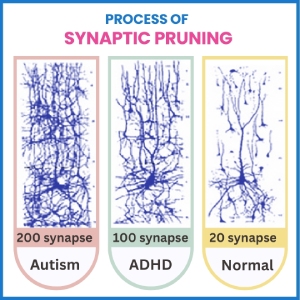
One hypothesis for a root cause of these experiences is a difference in the development of the brain in early childhood. All brains go through a process of “synaptic proliferation” (adding neurons to make many new connections) and then “synaptic pruning” (trimming out those neurons and connections that don’t match experience or aren’t useful). ASD brains may undergo less pruning; this allows for making connections where other people don’t see them, but also demands cognitive resources.
How Occupational Therapy Helps
Occupational therapy (OT) is customized to each person’s experience, needs, and life activities. In order to improve overall life performance, OT can help a patient:
- Understand the ASD experience and utilize strengths as a superpower
- Develop skills, habits, and routines that regulate the nervous system and maximize life performance
- Structure the physical/social environment in a way that supports overall functioning
- Practice in real-life contexts
- Find others who share the ASD experience
- Advocate for one’s self

