
A better word for “Neurodivergence” could be “neurodiversity”. These terms try to describe how there are many ways of experiencing and moving through the world that scientists are just starting to learn about. Aside from observed differences in things like sensory processing, social engagement, or ways of thinking, these same differences are often associated with differences in the actual structures of people’s brains and nervous systems.
It is important to remember that a difference is not necessarily a deficit or disability. Many accessibility rights advocates argue that the way communities have structured our physical and social environment creates the experience of disability, rather than an individual being limited in life or society. They argue that an inclusive society would seek out neurodiverse perspectives because those perspectives are of great benefit to the community.
Here are some ways that neurodiverse people experience the world differently:
| Sensory (sights, sounds, interoception, etc.) | Too sensitive or need more stimulation, or experience things like synesthesia (seeing colors or shapes with sound or taste) or aphantasia (inability to form pictures in the mind) |
| Social | Differences in reading social cues or communicating verbal/nonverbal messages in ways that others understand, communicating very literally or only in metaphor, or oversharing information |
| Executive functioning | May need specific kinds of neuro-regulation strategies for optimal executive functioning |
| Thinking patterns | May be good or poor at connecting the dots of big-picture ideas or fine details, or vice-versa |
| Learning | May be good or poor at making sense of or retaining certain kinds of information, or information presented in certain ways (e.g., written vs pictographic vs auditory) |
| Emotion regulation | May experience certain emotions more or less strongly than other people |
| Focus | May hyperfixate or struggle maintaining focus |
Some conditions are associated with common patterns of neurodiversity. A “condition” is essentially an observed pattern in a large number of people, and does not necessarily indicate dysfunction unless it causes distress for the person experiencing it. Here are a few of the “conditions” associated with neurodiversity:
- Autism Spectrum Disorder (ASD)
- Attention Deficit Hyperactivity Disorders (ADHD)
- Dyslexia
- Dysgraphia
- Obsessive-Compulsive Disorder
- Stroke
- Brain Injury
- Tourette’s Syndrome
- Sensory Processing Disorder (SPD)
- Dyspraxia
- Dyscalculia
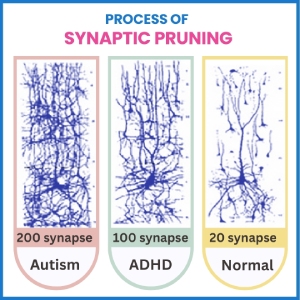
Some of the above “conditions” are associated with measurable differences in the structure or chemistry in the brain. For example, one hypothesis for a root cause leading to the experiences of people with ADHD and Autism is a difference in the development of the brain in early childhood. All brains go through a process of “synaptic proliferation” (adding neurons to make many new connections) and then “synaptic pruning” (trimming out those neurons and connections that don’t match experience or aren’t useful). In some conditions, including ADHD and Autism, less pruning takes place, which allows for making connections where other people don’t see them, but which also demands more cognitive resources.
Neurodiversity makes our communities smarter, more alert, more adaptable, more creative, and more resilient. Brain Tree seeks to help our communities make more room for neurodiversity, and help neurodiverse individuals thrive in their communities.

Understanding Neurotypical Communication
These strategies can help you communicate effectively with colleagues, friends, and family while being true to yourself.


