
The brain is an interconnected web, with many areas contributing to a particular skill/action. But, there are “centers” that are primarily responsible for a given skill/action. In general, something that requires more conscious effort uses a broader an area of the brain.
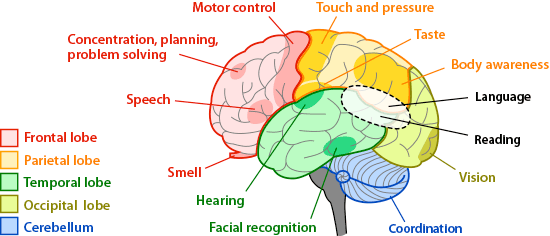
Executive Functions are complex, “higher level” skills that combine to achieve a larger goal. If there are difficulties with these essential skills, extra brain effort is required to achieve tasks and goals.
- Multi-tasking
- Problem-solving
- Planning
- Volition
- Working memory
- Learning/open-mindedness
- Sequencing steps/tasks
- Shifting tasks
- Inhibition/emotion regulation
- Sustained focus/attention
- Initiation
- Task completion
- Language skills
- Long term memory
- Short term memory
MAXIMUM effort
MODERATE effort
With changes to executive function often come other neurological changes. Difficulties with these “lower level” skills make the use of executive functions much harder.
- Balance/Coordination
- Gross/Fine motor control, including digestion
- Visual processing
- Experiencing Pleasure/Reward and Risk/Danger
- Modulation/Processing other senses: hearing, smell, taste, tactile, pain, hot/cold, proprioception (body position in an environment), and interoception (what’s happening inside the body)
Fatigue
Neurological difficulties are exhausting. A typical adult brain uses 20-30% of the body’s resources. An injured brain uses 30-50% of the body’s resources. The “Diathesis Stress Model”, which usually illustrates psychological stress, is also useful for illustrating combined, neuro-cognitive stress.

In Blue is the range of functional cognition. At the bottom of each bar is the level of input/stress is required to get up and start a day’s worth of tasks. At the top of each bar is the point at which a day’s tasks are overwhelming to the point of either shut-down or tantrum. As we grow up, we expand our resilience and range of function. For fully functioning adults, it might take some caffeine or a morning jog to get going, but we can tolerate a lot before we are overwhelmed.
In this example, recovering after a new injury involves slowly expanding one’s capacity. The goal is needing less effort to get started, lasting longer with a full cognitive load, and getting overwhelmed less easily.
Therapies
In therapy, we will map out the many variables affecting your capacity, and figure out which ones are the most feasible to improve. Then, we will get you the right tools, skills, habits, and routines to keep you performing at your best.
 Brain Tree